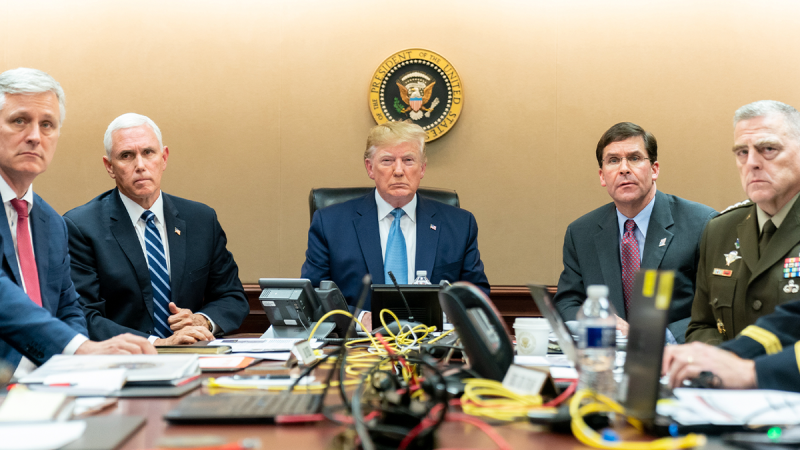
President Donald Trump has reported to the West Wing’s Situation Room multiple times in recent days as the conflict in Iran comes to a rolling boil and the U.S. considers launching its own attacks on the Islamic Republic over mounting concerns it could produce a nuclear weapon in a short span of time.
‘Yes, I may do it. I may not do it. I mean, nobody knows what I’m going to do. I can tell you this that Iran’s got a lot of trouble, and they want to negotiate,’ Trump told reporters Wednesday on the U.S. potentially striking Iran as it continues trading deadly strikes with Israel. ‘And I said, why didn’t you negotiate with me before all this death and destruction? Why didn’t you go? I said to people, why didn’t you negotiate with me two weeks ago? You could have done fine. You would have had a country. It’s very sad to watch this.’
Fox News Digital spoke to previous presidential administration officials — Fox News host and former Press Secretary Kayleigh McEnany, who served under the first Trump administration, and former National Security Advisor under the first Trump administration John Bolton, who also served as ambassador to the U.N. under President George W. Bush’s administration. They both conveyed the serious and historic tone the room and its meetings typically hold.
The Situation Room is a high-tech 5,000-square-foot complex in the West Wing of the White House that includes multiple conference rooms. President John F. Kennedy commissioned the complex in 1961 following the failed Bay of Pigs invasion to overthrow the Castro regime in Cuba that same year, according to the National Archives. The complex was built in order to provide future presidents a dedicated area for crisis management, and was revamped in 2006 and renovated again in 2023.
‘I often would sit there and think about the Osama bin Laden raid,’ McEnany told Fox News Digital in a phone interview Thursday morning. ‘This is where we saw our heroic Special Forces take out Osama bin Laden during the Obama administration. And I think we’re at another point where similar decisions are being made, and even bigger decisions that may change the course of history are happening right now in that room.’
Trump again held a meeting in the Situation Room Thursday morning, when he received an intelligence briefing with national security advisers, which followed a Situation Room meeting on Wednesday afternoon, another meeting on Tuesday afternoon with national security advisers and a Monday evening meeting upon his abrupt return from the G7 summit in Canada this week.
Top national security officials, including Secretary of Defense Pete Hegseth, Director of National Intelligence Tulsi Gabbard, Vice President JD Vance, Secretary of State Marco Rubio and Special Envoy to the Middle East Steve Witkoff, are among officials who have joined Trump in the meetings as the administration weighs the spiraling conflict.
Bolton explained to Fox Digital in a Thursday morning phone interview that two types of top-level meetings are held in the Situation Room.
The first is known as a ‘principals meeting,’ he said, which includes Cabinet secretaries, such as the secretary of state and secretary of defense, and is chaired by the national security advisor — a role currently filled by Secretary of State Marco Rubio.
‘The principals committee usually meets to try and get everything sorted out so that they know what decisions the president is going to be confronted with,’ Bolton said. ‘They try and make sure all the information is pulled together so we can make an informed decision, set out the options they see, what the pros and cons are, and then have (the president) briefed.’
The second type of Situation Room meeting at the top level are official National Security Council meetings, which the president chairs.
‘He chairs a full NSC meeting, and people review the information, update the situation, and the president can go back and forth with the advisors about asking questions, probing about the analysis, asking for more detail on something, kind of picking and choosing among the options, or suggesting new options,’ said Bolton, who served as Trump’s national security advisor between April 2018 and September 2019.
‘And out of that could well come decisions,’ he added.
McEnany served as the first Trump administration’s top spokeswoman at the height of the COVID-19 pandemic, when the Coronavirus Task Force operated out of the Situation Room as COVID-19 swept across the nation.
‘A lot of critical decisions were made during the pandemic,’ she said. ‘It’s a humbling encounter. Every time you go in, you leave your phone at the door. You go in, I think it’s like 5,000 square feet, you’re sitting there, there’s clocks up from every country around the world, the different time zones. And you’re just sitting there as critical decisions are made. And, in my case, it was regarding the pandemic, and there’s back and forth, there’s deliberation, and these decisions are made with the president there, obviously.’
She continued that during the pandemic, the task force would spend hours in the Situation Room on a daily basis as the team fielded an onslaught of updates from across the country. Trump frequently received the top lines from the meetings and joined the Situation Room during key decisions amid the spread of the virus.
‘When he was in there, absolutely, there’s a deference,’ she said, referring to how the tone of the room would change upon Trump’s arrival. ‘Yet, you had key officials who spoke up, who were not afraid to give their point of view to him. But I think there’s a recognition he’s the commander in chief.’
Press secretaries typically do not attend high-profile National Security Council meetings in the Situation Room, but have security clearances and can call into the room if needed, and are given updates from senior officials.
McEnany added that press secretaries wouldn’t typically want to be in the room for high-stakes talks because ‘you don’t want your head filled with these sensitive deliberations of classified information’ when speaking with the media.
Bolton explained that for an issue such as Iran, the Situation Room meetings are likely restrictive and include top national security officials, such as the secretary of defense, director of national intelligence and the chairman of the Joint Chiefs of Staff.
‘Sometimes it includes many more people, the Secretary of Homeland Security, the Commerce Secretary, things like that,’ he said. ‘But in with this kind of decision, it could be very restrictive, so maybe just – well, there is no national security advisor – but, Secretary of State, Secretary of Defense, Director of National Intelligence, CIA Director, Chairman of the Joint Chiefs of Staff, maybe the attorney general.’
Trump’s first national security advisor under the second administration, Mike Waltz, was removed from the role and nominated as the next U.S. ambassador to the UN in May, with Rubio taking on the additional role. The White House has also slashed NSC staffing since Trump took office, including after Rubio took the helm.
White House press secretary Karoline Leavitt held a press conference on Thursday — the first since Israel launched preemptive strikes on Iran June 12 — and said the next two weeks will be a critical time period as U.S. officials map out next steps.
‘I have a message directly from the president, and I quote: ‘Based on the fact that there’s a substantial chance of negotiations that may or may not take place with Iran in the near future. I will make my decision whether or not to go within the next two weeks.’ That’s a quote directly from the president,’ she said Thursday.
Israel launched pre-emptive strikes on Iran June 12 after months of attempted and stalled nuclear negotiations and subsequent heightened concern that Iran was advancing its nuclear program. Prime Minister Benjamin Netanyahu declared soon afterward that the strikes were necessary to ‘roll back the Iranian threat to Israel’s very survival.’
He added that if Israel had not acted, ‘Iran could produce a nuclear weapon in a very short time.’
Dubbed ‘Operation Rising Lion,’ the strikes targeted Iran’s nuclear and missile infrastructure and killed a handful of senior Iranian military leaders.
Trump repeatedly has urged Iran to make a deal on its nuclear program, but the country pulled out of ongoing talks with the U.S. scheduled for Sunday in Oman.
‘Iran should have signed the ‘deal’ I told them to sign,’ Trump posted to Truth Social Monday evening, when he abruptly left an ongoing G7 summit in Canada to better focus on the Israel–Iran conflict. ‘What a shame, and waste of human life. Simply stated, IRAN CAN NOT HAVE A NUCLEAR WEAPON. I said it over and over again! Everyone should immediately evacuate Tehran!’
Leavitt added during Thursday’s briefing that Trump is the ‘peacemaker-in-chief,’ while noting that he is also not one to shy from flexing America’s strength.
‘The president is always interested in a diplomatic solution to the problems in the global conflicts in this world. Again, he is a peacemaker in chief. He is the peace-through-strength president. And so, if there’s a chance for diplomacy, the president’s always going to grab it. But he’s not afraid to use strength as well,’ she said.
Fox News Digital reached out to the White House for additional comment on the high-level talks but did not immediately receive a reply.
