
 By
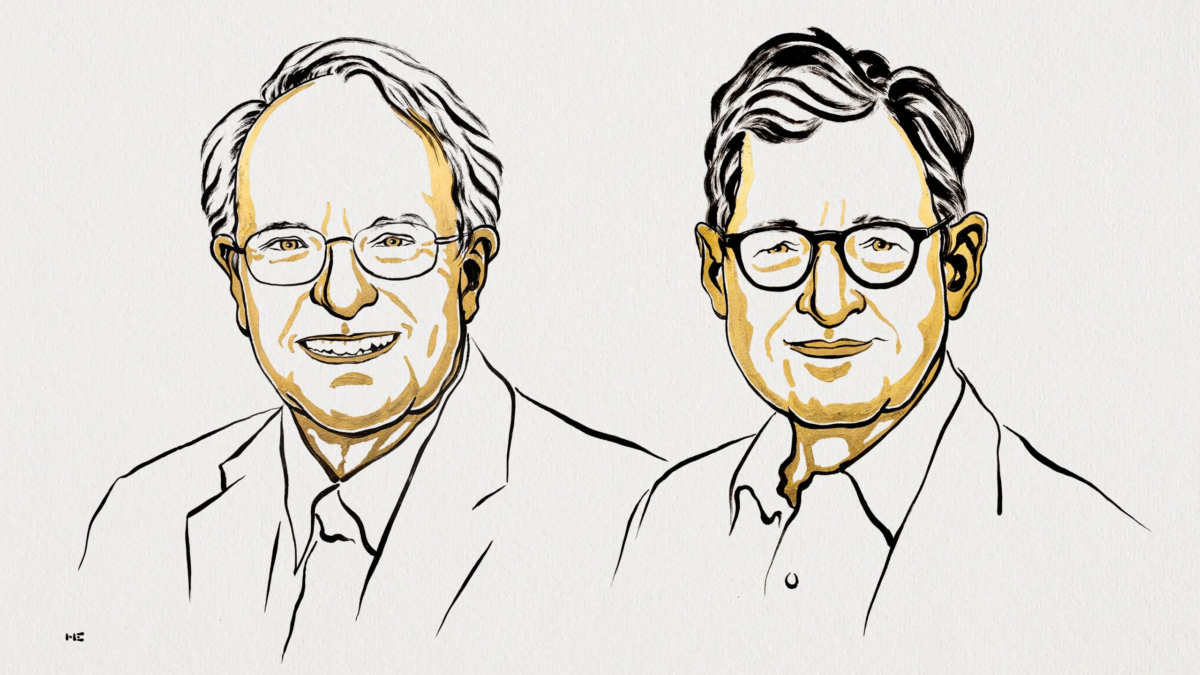
By Robert E. Hall and Michael Woodford were awarded the 2026 Nobel Prize in Economics on Monday for their work that helps smooth out the economy’s peaks and troughs.
The Royal Swedish Academy of Sciences announced the decision, honouring the duo’s work on “microeconomic foundations of macroeconomic stabilisation.”
Their work focuses on how decisions made by households and businesses influence the broader economy and how governments can account for these decisions when designing policies to maintain economic stability.
What did Hall and Woodford do?
Conventional economic thinking suggests that governments can manage fluctuations in economic activity through macroeconomic policies.
Policymakers can raise interest rates to slow an overheating economy and take the opposite approach to provide a boost during difficult economic conditions.
However, traditional economic models faced challenges during the oil crisis of the 1970s, prompting economists to look for better ways to understand and manage economic fluctuations.
Hall and Woodford expanded this understanding by developing models based on the microeconomic foundations of macroeconomic stabilisation.
A key element of their work is the recognition that households and businesses are forward-looking when making decisions about spending and saving.
Their expectations about future economic conditions influence their present-day choices, which in turn affect the broader economy.
Governments therefore need to take these expectations into account when formulating policies.
The duo also highlighted the importance of communicating future policy plans.
Because households and businesses look ahead when making decisions, clear communication from policymakers can influence their expectations and behaviour.
According to the award committee, the models have been particularly helpful in addressing economic downturns and improving the effectiveness of stabilisation policies.
The real-world impact
Since the work of the pair was published, the models have been developed and refined further, and the Nobel Prize committee says that this process can be expected to continue as our economies keep changing.
The models can also easily be adapted to the varying circumstances encountered by households and businesses.
According to the award committee, “the laureates’ research has made it possible to manage major macroeconomic crises far more effectively than before. It has been hugely beneficial during the pandemic and the energy crises of recent years, which have not had such long-term consequences for growth and inflation as in the critical periods of the 1970s.”
Who are Hall and Woodford?
Robert E. Hall is an American economist and professor at Stanford University. Born in California, he previously taught at the Massachusetts Institute of Technology and the University of California, Berkeley.
Hall is also credited with developing the concept of the flat tax alongside Alvin Rabushka, with whom he worked on the idea in the early 1980s.
Michael Woodford is a professor of political economy at Columbia University. He has previously taught at the University of Chicago and Princeton University.
Woodford is particularly known for his book Interest and Prices: Foundations of a Theory of Monetary Policy.
His work established important frameworks for understanding how central banks use interest rates and transparent communication to stabilise inflation and influence economic activity.
The post Why Robert E Hall, Michael Woodford won 2026 Nobel prize in economics? appeared first on Invezz
